
Koh Mui Kiang
Women Division
“Haven’t you had enough? Isn’t it time to try something different?” Sharon’s words caught me by surprise. For the first time, I gave her words some serious thought.
I am a working mother without a helper. As if balancing work, family and household chores were not enough, life threw me added curved balls.
Since January 2014, I was visiting my son’s school every other week due to his behavioural issues. I met up with almost everyone up the ranks, except for his school principal. He was on the verge of expulsion from school. At the same time, I was also struck by my father’s diagnosis of prostate cancer.
My buddy Sharon, who is both my neighbour and friend, walked the journey with me for many years. She had been sharing Nichiren Buddhism with me but I did not feel the need for a religion then – the outcome of an educated mind that made religion feel like a fallacy. As I stand today, I realise the only truth is the ignorance of an educated mind!
The Beginning of My Faith Journey
After hearing Sharon’s words, I recalled in the course of my work, meeting two SGS members who had left a strong impression on me as they maintained an optimistic disposition despite their work challenges. Sharon herself had also been displaying such an unwavering spirit.
I decided to give this Buddhist practice a try. I started doing weekly chanting at the house of a senior in faith.
A passage in the Gosho “Three Tripitaka Masters Pray for Rain” states, “Therefore, the best way to attain Buddhahood is to encounter a good friend. How far can our own wisdom take us? If we have even enough wisdom to distinguish hot from cold, we should seek out a good friend.” (WND-1, p. 598) Akin to the significance of good friends in the Gosho, SGS youth leaders constantly encouraged and supported my son.
My son seemed enlightened after his conversations with them and began to see things from the perspective of Buddhism. He became more appreciative of people and things around him and I could see a difference in the way he interacted with people around him including me. Slowly, our relationship improved and due to his transformation, people around him began to believe in him and support him. His Vice-Principal prevented his expulsion, while his choir conductor allowed him to fulfil his dream of going on a cultural exchange to Tokyo. During this period, my son also chanted and through the encouragement of the wonderful youth leaders, participated in SGS activities. With faith and practice, he saw actual proofs of faith in his own life.
After a year, I decided to take a step forward. I enshrined the Gohonzon in 2015.
My daughter lacked interest in her studies since young. Though she gave her best shot for her N-Levels, she failed to enter the Polytechnic Foundation Programme she was trying to get in. She also did not manage to secure a spot in polytechnic due to her O-Level results. The added challenge was when she tore her anterior cruciate ligament which runs diagonally in the middle of the knee. This incident ruined her dreams of becoming a dance instructor. She became very depressed as she was concerned about her future. However, I maintained an optimistic attitude and was more hopeful than ever, as I had chanted a lot of daimoku for her and was certain that whichever path she embarked on would be the best for her. Indeed, she ended up enrolling at Lasalle College of the Arts and is greatly enjoying her studies today.
Breakthroughs in My Family
Throughout my faith journey, I faced challenges in my marriage as well, due to differences in opinions with my husband. Sometimes, the relationship broke down and animosity crept in. There were numerous instances when I felt my marriage lacked a true purpose, and this affected my children too who witnessed our quarrels.
When I shared my struggle with a senior in faith, she encouraged me to rely on the strategy of the Lotus Sutra. It was then that I decided to chant for the happiness of my husband. Through faith, practice and study, I understood that my marriage situation was a manifestation of my fundamental darkness. I failed to do my human revolution and lacked the wisdom and compassion to empathise with him.
I set specific prayers to manifest Buddhahood in my daily life and build a harmonious family that would strive for kosen-rufu.
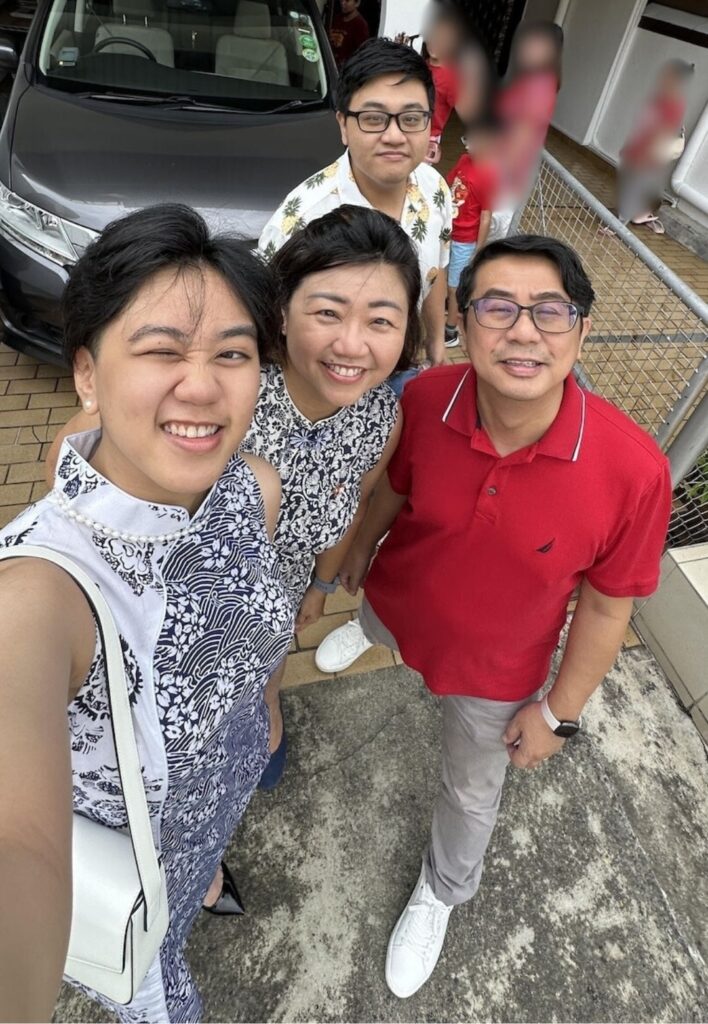
My husband was facing some challenges and it took a toll on our marriage. At a point, the marriage seemed irreparable. One day, however, he shared with me his intention to take up faith with the purpose of building his and our family’s happiness. We made more effort to communicate and address issues together as a couple. Since then, there has been significant improvement in our relationship, and we make it a point to go for meetings and do evening gongyo as a family.
To fuel his knowledge, he has been reading books by Ikeda Sensei and the Gosho. He told me that they are enlightening and beneficial. He also recently joined the Men’s Division (MD) function group, the Soka Lion Group with a strong intention to work for kosen-rufu.
I witnessed another breakthrough in my life when my parents who are non-practitioners, upon witnessing our family’s transformation, decided to join us in attending the monthly morning gongyo session at the Soka centre.
The Key to a Genuinely Fulfilling Life
Looking back, the concept of human revolution always intrigued me. Ikeda Sensei wrote, “A great human revolution in just a single individual will help achieve a change in the destiny of a nation and, further, will enable a change in the destiny of all humankind.”
I learnt through our Buddhist practice that we have the ability to transform our lives and our environment. Happiness is not about having a smooth-sailing life but taking on problems and adversity with an elevated life state and a strong life force, thereby transforming them into fuel for further growth and development. This is the way to enjoy a vibrant, dynamic, and genuinely fulfilling life.
Soka Gakkai Nationwide Women Division Chief Kimiko Nagaishi said during her visit to Singapore with a delegation in April this year, “By changing ourselves, we not only can bring about positive changes in the lives of others, we can also create harmony and mutual respect in our family and place of work.
‘Sensei once said that “human revolution and shakubuku (introducing Nichiren Buddhism to others) are two sides of a coin – they are one”. Inner transformation is an actual proof of one’s faith. And the practice that makes this transformation possible is shakubuku.’”
My husband and I are currently encouraging a close friend couple to practise Nichiren Buddhism to overcome their challenges. They have started chanting with us, albeit still at an infancy stage. My husband and I hope that we can be the “good friend” who will support and see them through until they too can see positive transformation in their lives.
Nichiren Buddhism has indeed transformed our lives in profound ways. From a marriage on the brink of divorce, we have cultivated not only a harmonious relationship but also one where we can work together for the happiness of others. With immense gratitude, as husband and wife, we are determined to apply our Buddhist practice in our daily lives and bring hope to more people around us.
(Adapted from December 2024 issue of Creative Life)